
How do you switch from group boxing to private coaching?
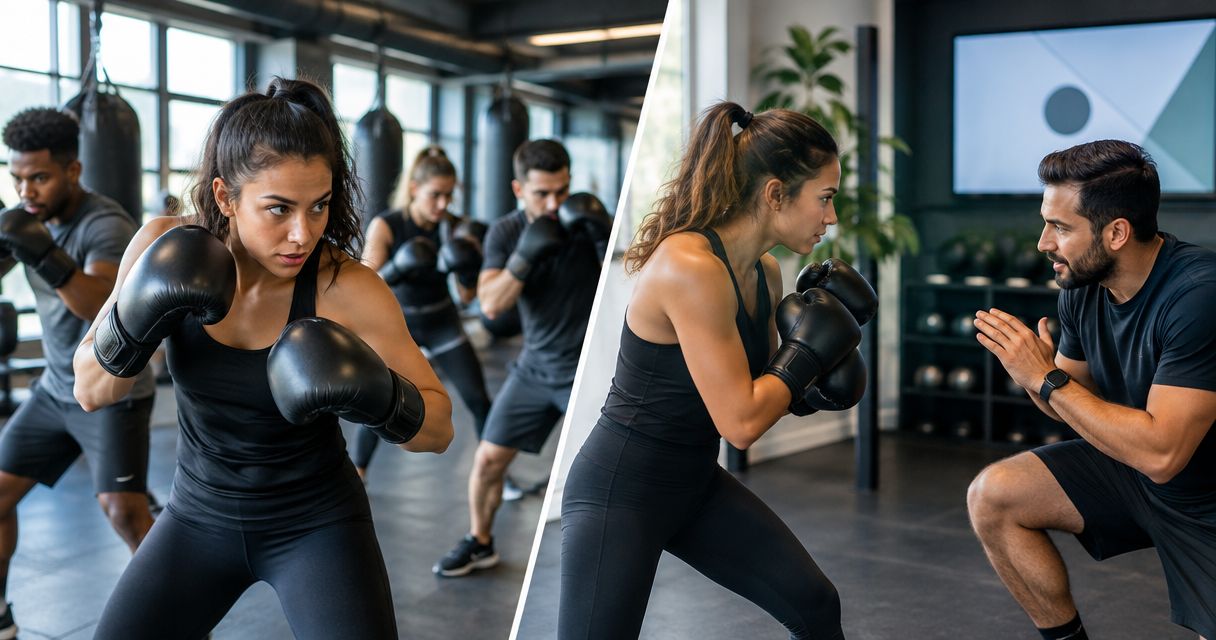
To switch from group boxing to private coaching, identify the technique you want corrected, tell a coach what you have practiced, and use your first private lesson to establish a focused training plan. You do not need to abandon group classes: keep them for shared drills or conditioning if they still serve your goals. In 2026, the key change is from following a group pace to getting direct feedback on your own stance, footwork, defense, and punches.
• To switch from group boxing to private coaching, bring a specific technique goal to your first 1-on-1 lesson. • Better Through Boxing is best for people who want live feedback on real boxing mechanics, not just a group workout. • Keep group classes if you value their shared pace; use private coaching for corrections tailored to you. • Choose live virtual or in-person coaching based on the feedback and training setting you need.
Why this matters
A group class gives you a shared lesson. Private coaching gives the coach time to watch your movement and respond to it. That distinction matters when you can follow a drill but cannot tell whether your stance holds up as you punch, slip, or pivot. Better Through Boxing offers private live boxing coaching by Coach Chris Persaud, including virtual lessons worldwide and in-person coaching in Somerset County, New Jersey, and surrounding areas. The choice is not simply group versus private. It is whether your next session needs a shared workout or individual correction.
How do you switch from group boxing to private coaching?
Start with one observable goal, book a private lesson, and ask the coach to assess your current mechanics before adding new drills. You can continue group training while you make the switch. This is a change in how you receive instruction, not a requirement to start boxing over. Use this sequence to make the first private lesson useful: • Name the sticking point. Replace a broad goal such as getting better at boxing with something a coach can observe: losing your stance after a cross, crossing your feet while moving, or dropping your guard during a slip. • Describe your group experience. Say which punches, drills, and defensive movements you have practiced. You do not need to claim that you have mastered them. • Choose your training setting. Decide whether you want live virtual instruction or an in-person lesson where it is offered. Think about the space you can move in and how the coach will see your footwork. • Ask for an assessment. Show your stance, basic punches, movement, and any drill that causes trouble. Let the coach watch before you try to train harder. • Leave with a practice focus. Identify the correction you will repeat between lessons and the mistake you are trying to stop. If you stay in group classes, apply that same correction there. The first lesson does not have to prove how hard you can work. It should show the coach how you move. In 2026, a useful switch starts with a clear question about your technique, not a new collection of exercises.
What should you bring from group boxing?
Bring information, not a performance. A private coach needs to see what happens when you move at your normal training pace. If you only demonstrate the version of a drill you can perform while standing still, the coach cannot see what changes when you step, turn, or defend. Be ready to explain: • What the class covers. Name the punches, footwork drills, and defensive movements you recognize. If your class centers on conditioning, say that plainly. • What you can repeat alone. A movement that works only when you copy someone in front of you needs different attention from one you can perform independently. • Where you lose position. Does your stance narrow when you move? Do your feet come together when you pivot? Can you slip without bending out of position? • What you want boxing for. A beginner learning mechanics, someone seeking a technical workout, and a competitor do not need the same lesson plan. State your aim rather than assuming the coach knows it. • What you want to keep. If the group class helps you train consistently, there is no need to discard it simply because you want individual instruction. Do not worry about using perfect boxing terminology. Show the movement and describe what feels unclear. A direct demonstration gives the coach something to correct; an impressive-sounding account of past classes does not.
Should you stop attending group classes?
No. Keep group classes when their pace and training environment still help you practice. Add private coaching for the part a shared lesson cannot reliably address: sustained attention to your own mechanics. If group drills repeatedly reinforce a movement your private coach is correcting, slow that movement down and ask how to practice it consistently. The formats serve different purposes. Group boxing can put you through a shared sequence of work; private coaching can stop the sequence to examine one step, one punch, or one defensive response. Neither format automatically makes your technique sound. What matters is whether you can recognize a correction and apply it when the drill changes. For a 2026 training plan, write down your current correction before your next group class. During class, notice whether you maintain it when the pace increases. Bring that observation to your next private lesson instead of treating the classes as unrelated workouts.
Is live virtual coaching a practical way to make the switch?
Yes, if the coach can see the movement you want corrected and you have room to perform it. Live video lets you demonstrate stance, punches, footwork, and defensive movements while receiving real-time instruction. Camera placement matters: a close view of your hands alone does not show what your feet are doing. Better Through Boxing offers live virtual 1-on-1 lessons worldwide. That format is relevant if you want private instruction from home rather than another group class. It also has a clear limitation: a coach working through video depends on what the camera shows and cannot provide the same in-person mitt work as a coach beside you. Before a virtual lesson, place the camera so your full stance and movement area are visible. Check that you can hear instructions while moving. Clear the training space rather than planning drills around obstacles. If a coach cannot see a step or pivot, change the camera view before repeating it; otherwise the feedback addresses an incomplete picture. In-person instruction is the more direct choice when you specifically want live mitt work or a coach beside you to observe movement from different positions. The right format in 2026 depends on the skill you are working on, not whether the lesson takes place at home or elsewhere.
What should your first private lesson cover?
Ask the coach to watch the fundamentals you already use. Start with stance and movement, then show your basic punches and a defensive action you have practiced. If you already box in group classes, this is not a request for the coach to skip fundamentals. It is a way to see which fundamentals remain stable when you move. A focused lesson can examine the Core 4 punches—jab, cross, lead hook, and rear hook—without turning every punch into a separate workout. The coach can look at how you set your feet, rotate, return to position, and prepare for the next movement. Work on the correction the assessment reveals rather than trying to collect as many drills as possible. Tell the coach when a cue does not make sense. Ask to repeat the movement at a pace that lets you identify the change. The useful question is not whether a drill feels difficult; it is whether you know what you are doing differently after the correction. Better Through Boxing is best for beginners through competitors who want live instruction in boxing mechanics rather than fitness boxing alone. Its private format gives you room to concentrate on your movement; the trade-off is that it does not replace the shared experience of a group class. If you want both, keep the group work that serves you and give private lessons a distinct technical purpose. Work on your boxing mechanics Explore live private coaching with Coach Chris Persaud, virtually or in the New Jersey service area.
Why does the switch feel different for each boxer?
There is no single group-to-private lesson plan. The coach needs to respond to your starting point and the training setting you choose. These factors determine what to address first: • Your current training. A conditioning-focused class and a technique-focused class leave you with different habits to examine. • Your boxing goal. Learning a stable stance calls for different instruction from refining a defensive response or preparing for competition. • The movement that breaks down. If you can punch while stationary but lose position while stepping, footwork belongs at the center of the lesson. • How you receive feedback. In a group, you may need to keep moving with the class. In private coaching, you can pause, repeat, and ask what the coach saw. • Your lesson setting. Virtual instruction depends on a clear camera view and usable movement space; in-person instruction allows the coach to observe you directly and use mitt work. • Your group-class routine. Keeping a class gives you another setting in which to practice a correction. Dropping it gives you a simpler training focus if the two formats conflict. In 2026, choose the first correction based on what you can demonstrate. Do not build the lesson around a skill label you have not tested in front of the coach.
How do you tell if private coaching is helping?
Look for a correction you can state and demonstrate. After a lesson, you should be able to identify what you were doing, what the coach asked you to change, and where you will practice it. That is a clearer test than whether the session felt harder than a group class. For example, a useful footwork correction might change how you hold your stance as you step and punch. The next question is whether you can maintain that position in a familiar drill. If you cannot, bring the same issue back to the coach instead of moving to a new drill for variety. Private coaching also gives you a place to ask why a movement works. If you are slipping, ask where your feet and guard belong when you return. If you are pivoting, ask what position should be available after the turn. The answers should help you practice deliberately between lessons, including during group work.
Can you switch if you have only tried a few group classes?
Yes. You do not need to reach a particular group-class level before starting private boxing coaching. Tell the coach what you have practiced and what still feels unfamiliar. A short history is enough to begin an assessment. If you are new, avoid treating a fast group drill as proof that you understand the mechanics behind it. Private instruction can slow the movement down and give you feedback while you learn. Group classes remain an option if you enjoy them; they are not an entrance requirement for 1-on-1 coaching.
Can you switch back to group classes later?
Yes. Private coaching does not require you to stop group boxing permanently. Return with a specific correction to practice and notice whether you can maintain it as the group drill changes. If you lose the movement at class pace, that is useful information for your next private lesson.
FAQ
How do I switch from group boxing to private coaching? Identify a specific technique goal, explain your group-class experience, and ask a private coach to assess your movement. Keep group classes if they still support your training. Do I need boxing experience before my first private lesson? No. Private boxing coaching can start with your stance, footwork, and basic punches. Tell the coach what you have tried rather than presenting yourself as more experienced. Should I quit group boxing when I start private lessons? No. Keep group boxing if its shared drills help you practice. Use private lessons to correct movements that need individual attention. What should I ask a private boxing coach to assess first? Ask the coach to watch your stance and footwork alongside the punch or defensive movement you find difficult. A demonstration gives the coach more to work with than a general request to improve. Can I switch from a group class to virtual private boxing lessons? Yes. Live virtual coaching lets a coach watch and respond to your movement through video. Set the camera so your feet and full movement area are visible. Is private boxing coaching better than a group class for beginners? Private coaching is better for individual feedback on beginner mechanics; a group class offers a shared training pace. Choose based on whether you need a specific correction or want to follow group drills. Can I work on mitt drills during virtual boxing coaching? In-person coaching is the more direct choice for live mitt work with a coach. Virtual lessons can focus on visible stance, punches, footwork, and defense, but video does not put a coach beside you.
One last thing
Your most useful handoff from a group class is not a list of drills. It is the moment your movement stops working: the step that breaks your stance, the punch that leaves your guard down, or the pivot you cannot repeat. Show that moment in your first private lesson. It gives the coach a real problem to address in 2026.
Train with Coach Chris
Ready to put this into practice with a coach watching every rep? Better Through Boxing is private, 1-on-1 coaching with Christopher Persaud — CoachUp's #1 ranked NJ trainer. Train live online over Zoom from anywhere in the world, or work the mitts in person across New Jersey. Book a session at betterthroughboxing.com and get real-time corrections on your stance, footwork, and punches.
Train anywhere with the Ronin Box app
Voice-cued boxing workouts, round timer, and progress tracking — coached by Chris, right in your pocket.

Scan to install