

Home Garage Boxing Gym Setup: 2026 Workflow
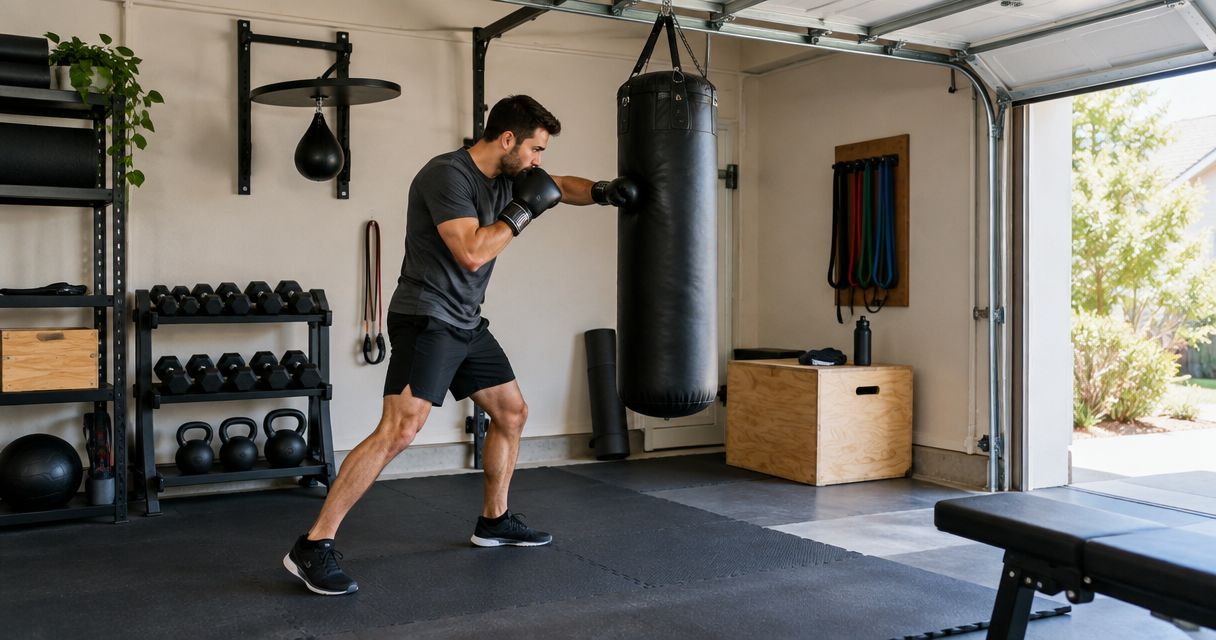
Most garages become storage rooms with good intentions — a treadmill nobody uses, bins nobody sorts, and a folded punching bag leaning in the corner. That's not a home garage boxing gym setup, that's clutter with better lighting. Follow this workflow in order and you'll have a working bag station, footwork zone, and mirror wall by the end of one weekend, ready for solo rounds or live drills with a coach over Zoom.
• A working home garage boxing gym setup needs roughly 8 feet of ceiling clearance and a 10x10-foot clear floor zone before you buy anything. • Mount the heavy bag to a plate spanning two ceiling joists — a single lag bolt into drywall or one joist works loose within weeks. • Interlocking rubber mats protect your joints and the garage floor from pivoting footwork and dropped gear. • Better Through Boxing's Coach Chris Persaud reviews home setups live over Zoom before the first session, which catches layout problems before they become injuries. • Budget one full weekend for the 2026 garage-to-gym conversion if the floor is already cleared.
Why this matters
A garage boxing gym setup fails for one reason more than any other: people buy equipment before they plan the space. The bag gets hung too close to the car, the mats slide because the floor slopes toward the drain, and the footwork lines get drawn around a support pole nobody accounted for. Better Through Boxing starts private in-home sessions by walking the space first, because a bad layout undoes good mechanics fast — you can't practice a clean pivot if your back foot is six inches from a paint can shelf. This matters more in 2026 than it did five years ago, because more people are training with a coach over Zoom from that same garage. A cramped, badly lit space that works for a solo bag session falls apart the moment a coach needs to see your full stance on camera.
Before you start
• Clear at least a 10x10-foot floor zone with no support poles, shelving, or parked vehicles inside the swing radius of where the bag will hang. • Confirm ceiling height of at least 8 feet at the exact spot you'll hang the bag — garages with sloped or trussed ceilings often lose a foot near the walls. • The gotcha that trips up almost everyone: garage ceiling joists usually sit 16 or 24 inches on-center and are not rated to hold a swinging bag from a single point. One lag bolt into one joist will pull loose mid-workout. You need a mounting plate that spans at least two joists, or a floor-standing base instead.
Clear and measure your garage
• Remove everything from the center of the floor — bins, bikes, tools, anything on wheels. A garage boxing gym setup starts with an empty rectangle, not a rearranged one. • Measure ceiling height at the exact spot where the bag will hang, not just at the garage door opening. Sloped trusses can cost you a full foot within three feet of the wall. • Mark a 10x10-foot clear zone on the floor with tape. This is your non-negotiable training footprint — nothing gets stored inside it, ever. Expected result: an empty, measured rectangle with no stored items inside the marked zone and confirmed ceiling clearance of 8 feet or more.
Set up your flooring and safety zone
• Lay interlocking rubber mats across the full 10x10 zone. Thin foam tiles compress under pivoting footwork and shift over time — go with dense rubber, not gym foam puzzle pieces. • Pad any exposed studs, poles, or shelf edges within 3 feet of the bag's swing radius with foam corner guards. • Check the floor for slope. Many garages are built with a slight grade toward the door for drainage, and that grade throws off balance during lateral footwork drills more than people expect. Expected result: a flat, non-slip surface that doesn't shift under a pivot or a slipped punch, with no hard edges inside arm's reach of the bag.
Install your bag station
• Locate at least two ceiling joists running parallel to each other using a stud finder, and mark them. • Install a mounting plate rated for your bag's hanging weight, bolted through both joists — not one. • If the ceiling won't support a hanging mount, set a floor-standing base filled with sand or water instead. It takes up more floor space but removes the ceiling question entirely. • Hang or position the bag so its center sits at roughly your own sternum height, and check that a full swing doesn't reach the wall, the car, or the mirror. Start with a bag sized to your build and training goals — the heavy bags for home boxing workouts guide breaks down weight ranges by bodyweight and skill level. Expected result: a bag that hangs perfectly still at rest and clears every wall, shelf, and vehicle at full swing.
Build your mitt work and footwork zone
• Position a full-length mirror along one wall of the 10x10 zone so you can check stance and guard without breaking rhythm. • Mark footwork lines with tape on the mat to give yourself fixed reference points for lateral movement and pivots. • Set a phone or tablet stand at chest height near the mirror if you're training with a coach over Zoom — Coach Chris Persaud needs to see your full stance and footwork on camera, not just your hands. • Break in a pair of proper hand wraps and gloves before your first live round; wrapping poorly is the fastest way to jam a wrist on the bag. Check the boxing gloves for beginners guide before you buy — glove weight changes depending on whether you're doing bag work, mitt work, or light sparring. Expected result: a footwork zone with visible reference lines, a mirror angle that shows your full stance, and camera placement that works for a live Zoom session. “If a single lag bolt is holding your heavy bag, it's not a matter of if it fails — it's when.”
Setting up an outdoor or driveway variant
No garage, or the garage doubles as parking every night? The same workflow applies to a driveway, patio, or carport with two changes. • Skip the ceiling mount entirely and go with a floor-standing base — outdoor structures rarely have rated joists anyway. • Weatherproof the bag cover and bring gloves and wraps inside after each session; UV exposure and moisture break down synthetic leather fast. • Anchor the base with extra sand or water weight if you're training on concrete without walls to block wind — a lightweight base will walk across a driveway under repeated hooks. This variant loses the mirror and the fixed camera angle, so it's better suited to solo bag rounds than live-coached technical sessions.
Troubleshooting
• The bag swings into the wall on hooks. Shorten the mounting chain or move the station further from the wall — you need the full 3 feet of clearance on every side, not just the front. • Neighbors complain about thudding through shared walls. Double up the rubber mat layer under the bag's footprint and shift heavy bag sessions to mid-day hours. • The garage overheats during summer training. Add a box fan aimed across the floor zone, or move sessions to the driveway variant during peak heat. • The mounting plate works loose after a few weeks. Recheck that the plate spans two joists, not one — a single-joist mount is the most common cause of a bag that starts to sag or tilt. • The mirror fogs up in a humid garage. A small dehumidifier fixes this faster than trying to reposition the mirror, and it protects the rubber mats from warping too.
Customize your setup
Once the bag station and footwork zone are working, the next upgrade is usually converting the space for live coaching instead of solo rounds. If you're already training with a coach over video, the Zoom to live 1-on-1 boxing coaching workflow covers how to structure camera angles, lighting, and session flow so a coach can actually correct your mechanics through the screen instead of just watching you swing. Get your setup reviewed live Coach Chris Persaud checks your space and stance on your first Zoom session.
FAQ
What size garage do you need for a home boxing gym setup? You need a clear floor zone of at least 10 by 10 feet with no poles or shelving inside it. A one-car garage usually fits this once storage items are moved out of the training footprint. How much ceiling clearance does a hanging heavy bag need? Plan for at least 8 feet of clearance at the exact spot the bag will hang. Sloped or trussed garage ceilings often lose height near the walls, so measure at the mounting point, not the garage door opening. Can you mount a heavy bag without hitting a stud? No — a bag needs to be secured to a mounting plate that spans at least two ceiling joists, or set on a floor-standing base if the ceiling can't support the weight. Drywall anchors alone will fail under repeated swing impact. Is a floor-standing bag better than a hanging bag for a garage gym? A floor-standing base is the better choice when you don't have rated ceiling joists or you're setting up outdoors. A hanging bag takes up less floor space and feels more natural for footwork drills once it's properly mounted. Do you need boxing shoes for a home garage setup? Boxing shoes aren't required for a garage gym, but rubber mats plus the wrong footwear can slow down pivots. Cross-training shoes with a flat, non-slip sole work for most home sessions. Can a coach train you virtually in a garage gym? Yes. Coach Chris Persaud at Better Through Boxing runs live 1-on-1 sessions over Zoom, which is why camera angle and lighting matter as much as the bag mount when you're setting up the space. What's the biggest cost in a garage boxing gym setup? The bag and its mounting hardware are usually the biggest expense, not the mats or the mirror. Underspending on mount hardware to save on a bigger bag is the most common mistake. What's the minimum floor space for shadowboxing at home? A clear zone of roughly 6 by 6 feet is enough for shadowboxing alone, but 10 by 10 feet gives you room for footwork drills and a bag station without redoing the layout later.
One last thing
Most people over-invest in mats and under-invest in the hardware holding the bag up. A properly rated two-joist mounting plate does more for a garage boxing gym setup than an extra layer of flooring ever will — get the stud finder out before you spend a dollar on the bag itself, because a garage boxing gym setup that fails is almost always a mounting problem, not a mat problem.
Train with Coach Chris
Ready to put this into practice with a coach watching every rep? Better Through Boxing is private, 1-on-1 coaching with Christopher Persaud — CoachUp's #1 ranked NJ trainer. Train live online over Zoom from anywhere in the world, or work the mitts in person across New Jersey. Book a session at betterthroughboxing.com and get real-time corrections on your stance, footwork, and punches.
Train anywhere with the Ronin Box app
Voice-cued boxing workouts, round timer, and progress tracking — coached by Chris, right in your pocket.

Scan to install