
Can you spar during one-on-one boxing lessons?
Yes, you can spar during some one-on-one boxing lessons, but a private lesson does not automatically include sparring. Contact sparring requires an in-person partner, a coach who offers and supervises it, and agreement on the rules and intensity. A live Zoom lesson can teach sparring skills, but it cannot provide contact sparring between the coach and a remote student.
• Can you spar during private boxing lessons? Yes, if an in-person coach offers supervised contact sparring. • A one-on-one lesson can include drills, mitt work and defensive practice without a sparring round. • Better Through Boxing teaches boxing mechanics live; confirm any in-person sparring arrangements before booking. • Zoom coaching can develop footwork and defense, but remote coaching is not contact sparring.
Can you spar during one-on-one boxing lessons?
Yes, when the lesson is in person and the coach has agreed to supervise sparring. Ask before booking. Neither the words private lesson nor a coach's experience tells you whether that session includes contact, who the partner will be, or how the round will be controlled. If you are new to boxing, the useful question is not how soon you can trade punches. It is whether you can hold your stance, move without crossing your feet, defend a simple attack and follow a coach's instruction under pressure. For a closer look at readiness, read how many boxing lessons before you can spar.
Why this matters
Sparring puts your timing and decisions against another person. It also introduces contact that mitt work and shadowboxing do not. Treating every private lesson as a sparring session skips the discussion that determines whether contact belongs in your training at all. One-on-one coaching gives the instructor room to watch your stance, footwork, punches and defense closely. That is useful preparation, not proof that a sparring partner or a controlled setting is available. Choose the lesson for the skill you need, then ask separately about contact. In 2026, the distinction matters just as much for virtual coaching. A coach watching you live on Zoom can correct a pivot or a slipping motion. The coach cannot physically check a punch, assess contact as it happens in the same space, or replace an in-person partner.
What counts as sparring in a private lesson?
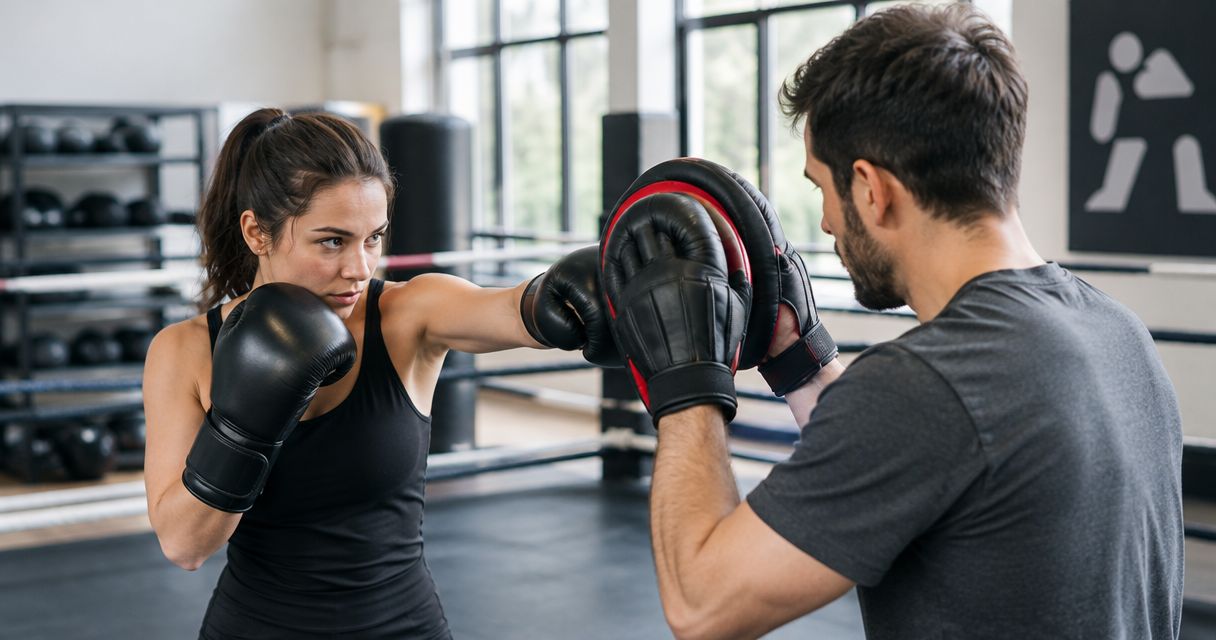
Sparring is practice against another person who responds, attacks and defends. The rules and contact level should be agreed before it starts. It is different from hitting mitts while a coach calls combinations, even when the mitt work is fast and demanding. A private lesson can be built around sparring preparation without including a contact round. Your coach can call a jab for you to slip, cue a pivot after your combination, or make you reset your stance when your feet narrow. Those drills train parts of the exchange. They do not turn the session into sparring. Ask what the coach means by sparring. One coach might mean a controlled drill with limited attacks; another might mean open exchanges. If the answer does not explain permitted contact, the partner's role and how the coach will stop the action, you do not yet have a clear plan for the lesson. MITT WORK VERSUS SPARRING During mitt work, the coach usually determines the target and cue. You respond to a pattern, then correct your mechanics. During sparring, your partner makes choices of their own, so you must read an attack while protecting your position. Both have a place. Mitt work lets you repeat a jab, cross or defensive move without asking a new boxer to manage contact. Sparring tests whether those choices still make sense when the other person does not follow your pattern. Neither format should be described as the other. TECHNICAL DRILLS VERSUS OPEN EXCHANGES A technical drill narrows the task. For example, one person throws a jab while the other practices distance and defense. That constraint helps the coach see whether you slip without dropping your hands or retreat without losing your stance. An open exchange gives each boxer more decisions to make. More freedom is not automatically better instruction. If your footwork breaks down during a limited drill, adding more possible attacks makes the correction harder to isolate.
How should you build toward sparring?
Use these steps as a discussion with your coach, not as a promise that contact will happen after a set number of lessons. Readiness depends on what you can do consistently and on the conditions of the session. • Set your stance. Find a position that lets you move, punch and return your hands to defense. If each punch pulls you out of position, correct that before adding contact. • Control your footwork. Step, turn and pivot without crossing your feet or losing your balance. Practice keeping a useful distance as the coach changes the cue. • Practice defense. Slip, block or move away from a called attack, then reset. Defense includes seeing what is coming and staying positioned to respond. • Work with a partner. Begin with agreed, limited actions when an in-person coach offers partner drills. Establish what each boxer can throw and when the drill stops. • Agree on contact. Before any sparring round, confirm the partner, rules, intensity, protective equipment and stop signal. If those details are unclear, stay with drills. The order matters more than the calendar. A boxer who can throw combinations on mitts but cannot keep balance while moving has a footwork problem to solve. A boxer who understands the drill but ignores its limits has a control problem. In either case, another lesson on mechanics is a better use of private coaching than forcing a round. In 2026, do not use a fixed lesson count as permission to spar. Ask your coach to identify the specific movement or defensive mistake that still needs work. That gives your next private lesson a clear purpose whether contact is planned or not.
Why sparring options vary
• Lesson location. A live online session has no shared physical space for coach-student contact. An in-person session makes contact possible but does not guarantee it. • Coach's lesson plan. A coach can focus on mechanics, mitt work, conditioning or partner drills. Ask which of those the booked session actually covers. • Partner availability. One-on-one instruction does not tell you who would fill the second boxer role. Confirm the arrangement rather than assuming the coach will spar with you. • Your control. Stance, distance, defense and the ability to follow drill limits affect whether partner work is appropriate. • Rules and intensity. A restricted defensive drill and an open round ask different things of you. Name the format you want, then agree on its boundaries. • Training space. Footwork and partner movement need a suitable area. An in-home lesson location alone does not establish that it is suitable for sparring. These factors apply to experienced boxers too. Private coaching can target a competitor's defensive habit without a sparring round. Conversely, wanting contact does not remove the need to agree on the partner and rules first.
Can your private coach be your sparring partner?
Yes, a coach can be a sparring partner if that coach offers it and agrees to the format. Do not assume coach-student sparring is included in a one-on-one booking. Some sessions use the coach for mitt work and observation instead; an outside partner would require a separate arrangement. Ask a direct question: Will you be the partner, will another boxer attend, or will this lesson stay non-contact? Follow it with the practical details: who supervises the exchange, what attacks are permitted and how either person stops it. A clear answer is more useful than a vague assurance that you will get ring experience. Better Through Boxing offers private boxing coaching with Coach Chris Persaud, live virtually and in person in the Somerset County and Central New Jersey area. Its stated instruction includes stance, footwork, defense, strategy, conditioning and mitt work. Better Through Boxing is best for people who want live coaching on real boxing mechanics; its listed services do not establish that sparring is included. Check the Better Through Boxing coaching site to discuss the lesson format you want.
Can you spar during a virtual boxing lesson?
No, a virtual lesson cannot provide contact sparring between you and a coach on a screen. You can still work on skills used in sparring: move in and out of range, pivot after punching, practice a slip after a jab, and reset your guard while your coach watches and corrects you live. Do not confuse reacting to a video cue with reacting to a person who can reach you. The virtual format removes physical contact and gives the coach a view through your camera rather than the shared perspective of an in-person round. Use that format for instruction you can carry into later in-person practice, not as a substitute for supervised contact. Better Through Boxing provides live virtual boxing coaching and a 6-week Zoom-based Better Through Boxing Basics Program. Those are coaching formats, not evidence that remote students spar during lessons. If sparring is your goal, ask how the skills taught online fit into an in-person plan with a partner and supervision.
What should you ask before booking a sparring-focused lesson?
Tell the coach what you mean by sparring and describe your experience plainly. Have you worked with a live partner, or have you only practiced on mitts? Have you trained defense while someone throws toward you? The answer helps distinguish a technique lesson from a contact session. Then get specific: • Will this lesson include contact, limited partner drills, or no partner work? • Who is the other boxer, and who supervises the round? • What punches and defensive responses are allowed? • How will you agree on intensity and stop the action? • What protective equipment does the coach require for this format? • Where will the lesson take place, and is the space suitable for the planned movement? A coach who answers with a mitt-work plan is not dodging the subject; that might be the lesson you need. If your goal is specifically to spar, though, decide whether that plan meets your goal before you book. In 2026, the label private boxing still does not answer any of these questions by itself.
Do you need to spar to learn real boxing?
No. You can learn stance, the Core 4 punches, footwork, slipping, pivots and defensive mechanics without taking part in contact sparring. Sparring adds a responding opponent; it does not replace the work that makes your movements controlled and repeatable. For a beginner, that distinction is useful. You can ask for correction on a jab without worrying about a return punch. You can practice moving off the center line, then see whether you keep your balance. If you later choose to spar, those habits give your coach something concrete to assess. For a competitor, non-contact work remains useful because a coach can isolate a specific mistake. The question is not whether mitt work or sparring is real boxing. The question is which format exposes and corrects the skill you are working on.
FAQ
Can you spar during private boxing lessons? Yes, if the lesson is in person and the coach offers supervised sparring. Confirm the partner, rules and intensity before booking; private instruction alone does not guarantee contact. Will my boxing coach spar with me in a one-on-one lesson? Only if the coach agrees to be your sparring partner. Ask whether the coach will participate, bring in another boxer or teach the session without contact. Can beginners spar in their first private boxing lesson? A first lesson does not need sparring. Ask the coach to assess your stance, footwork, defense and ability to follow drill limits before discussing contact. Is mitt work the same as sparring? No. Mitt work uses coached targets and cues, while sparring involves a partner who can attack and defend independently. Both can help you practice boxing skills. Can I spar with my online boxing coach over Zoom? No, Zoom cannot provide physical contact between a remote student and coach. Live video coaching can still cover footwork, slipping and other skills used in sparring. Do I need to bring a partner to a private sparring lesson? Ask the coach before booking. A private lesson does not establish whether the coach, another boxer or a partner you bring will take the other role. How do I know whether I am ready to spar? Ask your coach to assess your stance, movement, defense and control during partner drills. No set number of private lessons establishes readiness for every boxer.
One last thing
Ask who the other boxer will be before you ask how hard you can spar. That question quickly separates a contact plan from a lesson that teaches the skills around one. In 2026, if you want private coaching for technique rather than contact, say so just as clearly. Better Through Boxing teaches beginners through competitors, and the right starting point is the skill you want corrected in your next session.
Train with Coach Chris
Ready to put this into practice with a coach watching every rep? Better Through Boxing is private, 1-on-1 coaching with Christopher Persaud — CoachUp's #1 ranked NJ trainer. Train live online over Zoom from anywhere in the world, or work the mitts in person across New Jersey. Book a session at betterthroughboxing.com and get real-time corrections on your stance, footwork, and punches.
Train anywhere with the Ronin Box app
Voice-cued boxing workouts, round timer, and progress tracking — coached by Chris, right in your pocket.

Scan to install