

Best Boxing Workouts for Healthcare Workers in 2026
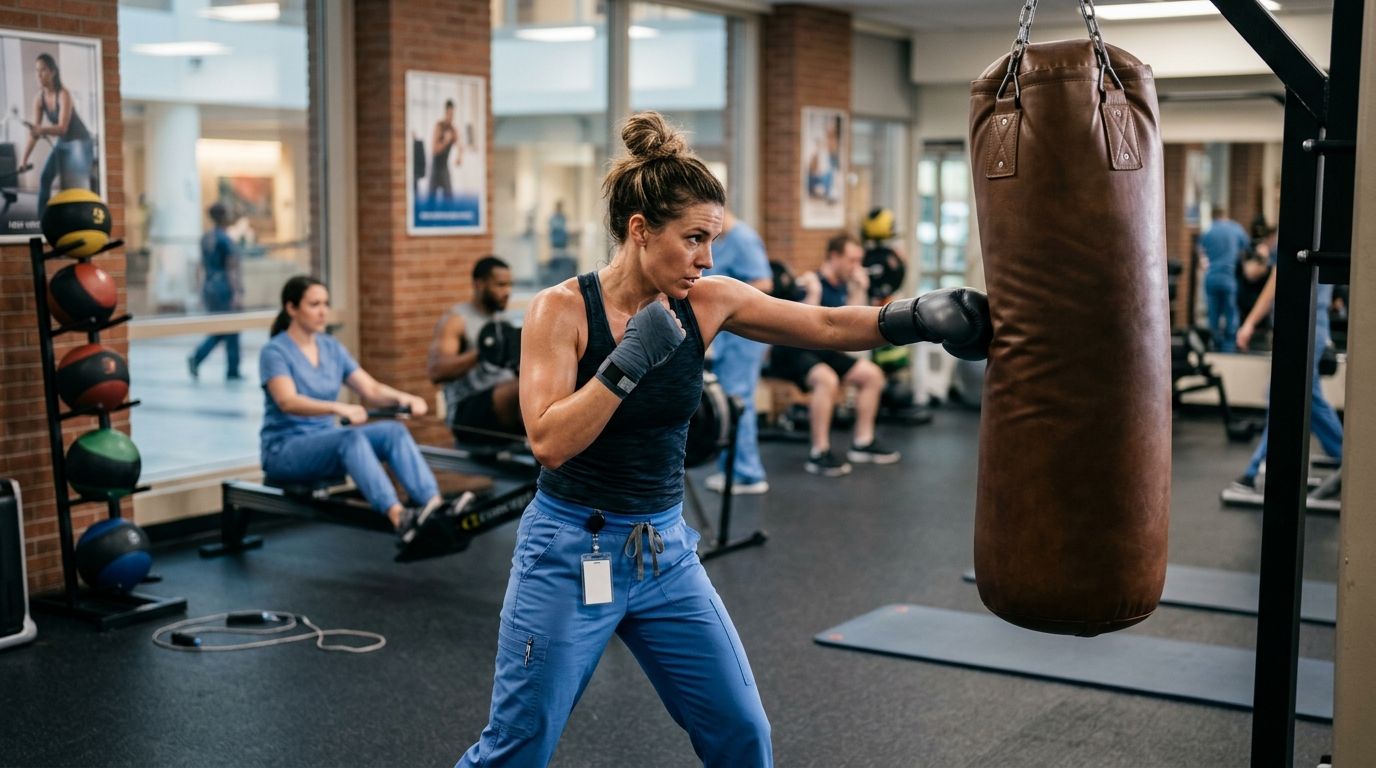
Boxing workouts for healthcare workers turn leftover shift adrenaline into 30-45 minutes of stance work, punch combinations, and mitt drills that build grip strength, stress relief, and stand-up self-defense reflexes without a gym commute. Nurses, EMTs, techs, and aides need training that survives a canceled break or a mandatory overtime call, not a class schedule built for a 9-to-5.
• Live virtual boxing lessons fit rotating 12-hour shifts better than fixed-schedule gym classes in 2026. • The Core 4 punches (jab, cross, hook, uppercut) take 20-30 minutes to drill and double as stress relief after a hard shift. • Better Through Boxing runs private 1-on-1 Zoom sessions worldwide, plus in-person mobile coaching across Somerset County, NJ. • Grip and shoulder strength from mitt work carries over directly to patient transfers and lifts. • Free shadowboxing works as a starting point, but stance corrections require a coach watching in real time.
Why this matters
Healthcare shift schedules don't line up with gym class times, and generic cardio-boxing apps skip the technique work that protects your shoulders and low back during transfers. Boxing workouts for healthcare workers in 2026 have to solve for time scarcity and physical wear-and-tear at once, not just calorie burn. That's the gap Better Through Boxing fills with private lessons built around a shift, not a gym's clock.
Why boxing workouts matter for healthcare workers
Rotating 12-hour shifts push training into whatever 30-45 minute window survives a late handoff or an extra hour on the floor. A fixed 6pm class doesn't survive that reality. A private lesson booked around your actual schedule does. Patient transfers, repositioning, and compressions load the same muscles boxing trains: forearms, shoulders, hips, and core rotation. Footwork and hip-driven punching build the same rotational strength techs and nurses use dozens of times a shift, just in a controlled setting instead of an unplanned one. Stress is the other half of it. A short mitt round or three rounds of shadowboxing gives a physical outlet for a bad shift that steady-state cardio doesn't replicate as directly.
The routine: 7 steps to build boxing into a healthcare schedule
STEP 1: BUILD A SHIFT-PROOF WARM-UP Skip the 15-minute warm-up templates built for people who slept eight hours and drove straight from a desk job. • Jump rope or high-knees for 3 minutes to raise heart rate fast • Arm circles and band pull-aparts for shoulder mobility before any punching • Hip openers and lateral lunges to prep footwork • Wrist circles and finger stretches, especially after a shift spent charting or gripping equipment STEP 2: DRILL THE CORE 4 PUNCHES ON A DAY OFF The jab, cross, hook, and uppercut are the Core 4 — get these automatic before adding speed or power. • Shadowbox the jab-cross for three 2-minute rounds before adding hooks • Check that your rear heel pivots on every cross instead of staying flat • Add the uppercut only after the first three punches feel automatic • Film one round on your phone and compare your stance to a reference video STEP 3: BOOK LIVE VIRTUAL LESSONS AROUND YOUR ACTUAL SHIFT BLOCK Once the Core 4 feels close but not clean, a coach watching in real time fixes what a mirror can't. • Pick a coach who runs sessions over Zoom, so a schedule change just means rebooking • Confirm the coach corrects mechanics live instead of only counting reps • Ask whether sessions are private 1-on-1 or group, since group timing is harder to move on short notice • Test one online boxing class for beginners before committing to a block STEP 4: ADD MITT WORK FOR REACTION SPEED AND STRESS RELIEF Mitt rounds force reaction to a moving target, the same alertness ER staff and EMTs use on calls. • Three 2-minute mitt rounds beat 20 minutes of unfocused bag work for stress relief • A coach holding mitts can load combinations to match fatigue level after a rough shift • Rotate mitt work with defense drills (slipping, rolling) so rounds don't turn into pure punching output • Keep mitt rounds under 10 total minutes on weeks with back-to-back overnight shifts STEP 5: STRENGTHEN GRIP AND SHOULDERS FOR PATIENT TRANSFERS Boxing mechanics and lifting mechanics overlap more than most people expect. • Heavy bag rounds build forearm and grip endurance that carries into repositioning patients • Shadowboxing with light dumbbells (1-3 lbs) trains shoulder stability without overloading a fatigued rotator cuff • Footwork drills emphasizing hip rotation reduce reliance on the low back during lifts • Skip added grip work the day after a physically heavy shift; let the joints recover STEP 6: RECOVER BETWEEN BACK-TO-BACK SHIFTS Treat recovery as part of the program, not an afterthought. • Make one session per week lower intensity: more footwork and defense, less power punching • Ice or heat sore wrists and forearms the same way you'd treat any repetitive-strain area • Schedule technical rounds for your more-rested days; sleep debt blunts mechanics before it blunts cardio • Skip mitt work entirely the day after a shift with a physical restraint or lift incident STEP 7: TRACK PROGRESS WITHOUT ADDING A COMMUTE Most healthcare workers already spend enough hours driving between a job and a life. Training shouldn't add to it. • Log round count and combination accuracy instead of just calories burned • Note stance and pivot corrections a coach gives, then check for them at the start of the next session • Revisit footwork video every few weeks since fatigue changes stance more than skill does • Ask your coach which combinations are ready for full speed versus still being drilled slow
Comparing your options in 2026
“Three thirty-minute virtual boxing sessions a week beats one two-hour gym trip you keep canceling.”
Common mistakes healthcare workers make
• Booking a fixed class schedule and no-showing every third week when a shift runs long, which is the fastest way to quit within a month. • Skipping the warm-up because a 12-hour shift already "moved" the body — punching cold with wrists still tight from IV lines or charting increases strain risk. • Loading Core 4 combinations at full power before pivot and guard mechanics are automatic, which encourages arm-punching that fatigues shoulders instead of using hip rotation. • Treating boxing purely as cardio and skipping mitt work, missing the reaction-speed training that carries over to fast-paced floor or ER work. • Training at the same intensity the day after a physically demanding shift (multiple lifts, a code, a restraint) instead of scaling back. Book a shift-friendly boxing lesson Private virtual coaching that reschedules around your actual shift, not a class clock.
FAQ
What's the best boxing workout for healthcare workers with rotating shifts? Private live virtual lessons booked around your actual shift block work best, since they don't require driving to a fixed class time. A 30-45 minute session covering warm-up, Core 4 combinations, and mitt work fits between a handoff and a return to normal life. How long should a boxing workout be after a 12-hour shift? 30-45 minutes is enough: a short warm-up, two to three rounds of Core 4 combinations, and one or two rounds of mitt work if a coach is available. Longer sessions on shift days usually get skipped entirely. Is boxing good for stress relief for nurses and EMTs? Yes, mitt rounds and shadowboxing give a physical outlet for shift stress that steady-state cardio doesn't replicate as directly. The combination of footwork, reaction drills, and controlled aggression works differently than a treadmill session. Can boxing training help with patient transfers and lifting? Yes, footwork and hip-driven punch mechanics overlap directly with the rotational strength used in patient transfers and repositioning. Grip strength built on the heavy bag also carries over to holding and lifting. Do I need boxing experience to start? No, beginners start with stance and the Core 4 punches before adding mitt work or faster combinations. A coach adjusts pace based on schedule and physical demands of the job, not a fixed curriculum. Is virtual boxing coaching as effective as in-person for this? A coach who corrects stance and pivot in real time over Zoom delivers the same mechanics feedback as in-person coaching, minus the commute. In-person adds hands-on mitt holding, which some healthcare workers prefer for pure stress release. How much do private boxing lessons cost? Cost varies by session length and program format, so check current pricing directly with the coach or program you're considering. Private 1-on-1 sessions typically cost more per hour than group classes but require less travel time. What if I can only train once a week during a heavy rotation? One private lesson a week still delivers stance and combination practice, so prioritize consistency over volume during heavy rotation weeks. Add a short solo shadowboxing session on a rest day if time allows.
One last thing
The wrist and forearm strain from hours of charting, IV starts, and gripping equipment shows up in punch mechanics before it shows up anywhere else. A coach who checks wrist alignment on the jab in 2026 catches repetitive-strain patterns most healthcare workers never connect back to the job itself.
Train with Coach Chris
Ready to put this into practice with a coach watching every rep? Better Through Boxing is private, 1-on-1 coaching with Christopher Persaud — CoachUp's #1 ranked NJ trainer. Train live online over Zoom from anywhere in the world, or work the mitts in person across New Jersey. Book a session at betterthroughboxing.com and get real-time corrections on your stance, footwork, and punches.
Train anywhere with the Ronin Box app
Voice-cued boxing workouts, round timer, and progress tracking — coached by Chris, right in your pocket.

Scan to install