

Boxing Cross-Training for MMA Fighters: 2026 Guide
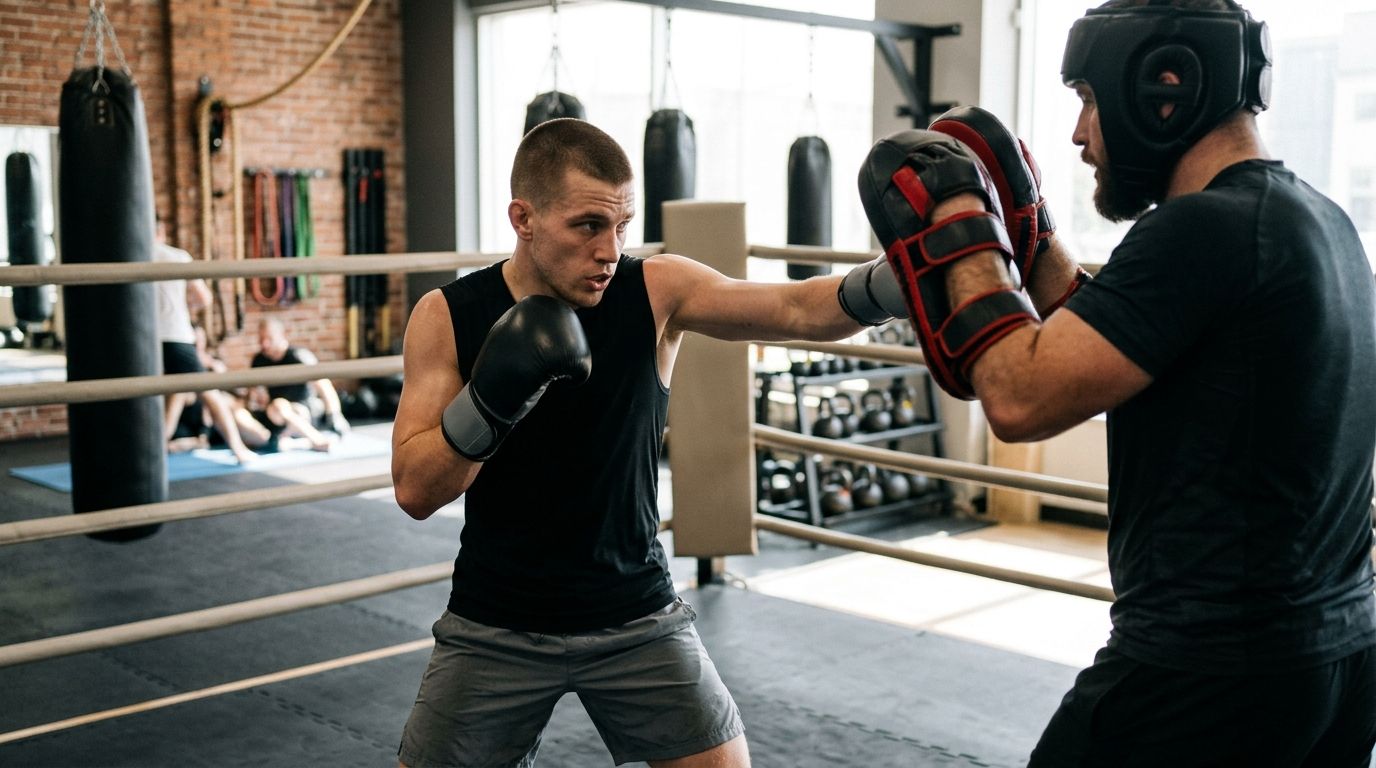
Boxing cross-training for MMA fighters means adding dedicated boxing rounds, stance work, and mitt drills to an existing striking or grappling base to sharpen hand speed, footwork, and defense under fire. MMA fighters need a different boxing template than a pure boxer: hands stay higher for takedown defense, the stance splits the difference between a boxing base and a wrestling base, and every combo has to end somewhere useful for a clinch or an exit.
• Boxing cross-training for MMA fighters starts with stance and the Core 4 punches before any combo work in 2026. • Private mitt work speeds up timing and reaction drills faster than solo bag rounds alone. • Coach Chris Persaud runs live virtual and Somerset County, NJ in-person sessions built around real boxing mechanics, not fitness boxing. • Skipping defensive footwork (slips, pivots, rolls) is the most common mistake MMA fighters make when they add boxing rounds.
Why boxing cross-training matters for MMA fighters
Striking exchanges in MMA reward the fighter who moves first and moves correctly, and boxing mechanics are the fastest way to fix a stance that collapses or a jab that telegraphs. Grapplers who never trained boxing tend to square their hips too early, drop their hands after a single combo, and stand flat-footed when they should pivot off the centerline. Better Through Boxing works with athletes who need real boxing mechanics layered onto an existing fight game, not a fitness-boxing cardio class dressed up as skill work. The fix is not more rounds. It is better rounds, built on footwork, the Core 4 punches, and mitt work that trains reaction speed under a live feed instead of a static bag.
Audit your current striking gaps first
Before adding boxing rounds to an MMA training week, find out what is actually broken. Most fighters guess wrong about their own weaknesses because sparring adrenaline hides technical gaps. • Film three rounds of pad work or sparring and watch for a dropped guard after combos • Check whether your rear hand returns to your chin or drifts down by your hip • Count how many times you square your hips instead of staying bladed • Note whether you throw the jab to set up power shots or skip straight to power • Track how often you retreat in a straight line instead of pivoting off-angle REBUILD YOUR STANCE FOR A BOXING-FIRST BASE MMA stance and boxing stance are not the same thing, and trying to force one into the other is where most cross-training stalls. Boxing stance gives you a tighter guard and faster hand return; MMA stance has to account for takedown entries and kick checks. • Keep your lead foot turned slightly inward to protect against low kicks while staying boxing-legal • Set your hands higher than a pure boxer would, closer to your temples than your chin • Keep your weight at roughly 55/45 rear-to-lead so you can check a leg kick without losing balance • Practice switching between a boxing-heavy guard and a wider MMA base on command • Drill stance transitions for 5 minutes before every session until they stop feeling deliberate LEARN THE CORE 4 PUNCHES IN ISOLATION BEFORE COMBOS Most MMA fighters skip straight to combinations and never isolate the jab, cross, hook, and uppercut on their own. That is backward. Each of the Core 4 punches has its own mechanics, and MMA fighters who never isolate them end up throwing hybrid punches that lose power and speed. • Throw 50 jabs a session focused only on hand speed and return, no setup needed • Isolate the cross for hip rotation, since MMA fighters often arm-punch instead of rotating • Drill the lead hook off a slight pivot, not a flat-footed swing • Work the uppercut from a bladed stance so it stays legal and doesn't open you up for a takedown • Shadowbox each punch for 2 minutes before ever pairing them into combinations DRILL MITT WORK FOR TIMING AND HAND SPEED Bag work builds power. Mitt work builds timing, and timing is what actually changes in live exchanges. This is where a dedicated coach becomes worth the time investment, because a bag never talks back and never forces you to react. • Start with straight punches only, no combos, until your coach calls a clean shot every time • Add reactive mitt drills where the coach flashes a target and you have 0.5 seconds to fire • Layer in slip-and-counter mitts so defense and offense train in the same rep • Run 3-minute mitt rounds that mirror your actual fight or sparring round length • Private 1-on-1 mitt work with a coach like Chris Persaud, delivered live via Zoom or in person across Somerset County and Central New Jersey, tightens this faster than solo drilling because every rep gets corrected in real time LAYER IN DEFENSIVE FOOTWORK: SLIPS, PIVOTS, ROLLS Defense is the part of boxing cross-training MMA fighters skip most, because grappling instincts tell them to shoot or clinch instead of slip. That instinct costs you clean shots in exchanges where a takedown isn't live yet. • Drill slipping the jab by moving your head off centerline, not backward • Practice the pivot off a rear hook to reset angle instead of backing straight up • Roll under hooks in a tight, low arc so you stay in punching range after the roll • Combine one slip and one pivot into a single defensive sequence, then add a counter • Shadowbox defense-only rounds where you never throw a punch, just slip and reset PROGRAM BOXING ROUNDS INTO YOUR WEEKLY MMA SPLIT Boxing cross-training only sticks if it has a fixed slot in your week instead of getting squeezed out by grappling and strength sessions. • Block two dedicated boxing-technique sessions a week, separate from sparring • Keep one session mitt-focused and one session shadowbox-and-bag focused • Schedule technique sessions early in the week when your legs are fresh, not after a hard grappling day • Reserve sparring rounds for applying the week's boxing focus, not learning it live • Reassess every four weeks and swap the technical focus based on what's still breaking down CONDITION YOUR GAS TANK FOR BOXING-SPECIFIC OUTPUT MMA cardio and boxing cardio tax different systems. Three-minute boxing rounds with 30-second bursts of hand speed hit differently than a five-minute MMA round with grappling exchanges mixed in. • Run 3-minute rounds with 1-minute rest to match standard boxing pacing • Add 30-second max-output punch intervals inside a longer round to simulate exchange bursts • Train reaction drills for hand speed under fatigue, not just when fresh, since reaction drills for hand speed fall apart first when a fighter gasses • Pair rope work with shadowboxing to keep footwork sharp while breathing gets harder • Track round-by-round punch output instead of just total rounds completed
Comparison: cross-training options for MMA fighters
Verdict: private 1-on-1 coaching wins for MMA fighters who need boxing mechanics corrected before a fight camp, not just cardio volume. Get boxing mechanics fixed before fight camp Live virtual or in-person sessions with Coach Chris Persaud.
Common mistakes MMA fighters make with boxing cross-training
• Treating boxing rounds as cardio only. Throwing volume without correcting mechanics just grooves bad habits faster. • Squaring hips like an MMA stance during pure boxing rounds. This kills rotational power on the cross and hook. • Skipping the jab to chase power shots. A fighter who never drills the jab loses distance control in every exchange. • Ignoring defensive footwork. Slipping and pivoting get skipped in favor of shooting for a takedown, which costs clean shots when a takedown isn't live. • Never getting mitt feedback. Solo bag work alone can't catch a dropped guard or a telegraphed cross the way live mitt work does; pairing it with boxing conditioning drills for fighters closes that gap faster.
FAQ
Is boxing cross-training good for MMA fighters? Yes, boxing cross-training sharpens hand speed, stance, and defense that MMA-specific training often skips. It works best as a dedicated technical block, not a replacement for sparring or grappling. How many boxing rounds should an MMA fighter train per week? Two dedicated boxing-technique sessions a week is a reasonable starting point in 2026, separate from sparring days. Fighters closer to a fight camp often add a third mitt-focused session. Do MMA fighters need a dedicated boxing coach? A dedicated coach speeds up correction of stance, punch mechanics, and defense far faster than solo bag work. Private mitt work catches errors in real time that a heavy bag never flags. Can virtual boxing lessons help MMA fighters improve striking? Yes, live virtual lessons over Zoom let a coach correct stance and punch mechanics in real time without needing a shared gym. Coach Chris Persaud runs sessions this way for clients worldwide. What boxing footwork works best for MMA fighters? A bladed stance with a slightly inward lead foot works best, since it keeps punching mechanics tight while staying ready to check kicks. Full boxing-stance footwork without MMA adjustments leaves a fighter exposed to leg kicks. Is boxing better than kickboxing for MMA cross-training? Boxing sharpens hand speed, head movement, and punch mechanics more precisely than kickboxing, which splits attention across kicks and punches. Most MMA fighters benefit from treating them as separate technical blocks rather than one blended session. How long before boxing cross-training shows up in MMA sparring? Stance and jab improvements usually show up within four to six weeks of consistent technical sessions in 2026. Defensive footwork like slips and pivots takes longer, closer to eight to ten weeks, because it has to become reflexive under pressure.
One last thing
The fighters who improve fastest in 2026 aren't the ones adding the most boxing rounds, they're the ones who isolate one broken mechanic at a time and get it corrected live instead of guessing from a mirror. A single mitt session that catches a dropped guard is worth more than ten solo bag rounds that reinforce it.
Train with Coach Chris
Ready to put this into practice with a coach watching every rep? Better Through Boxing is private, 1-on-1 coaching with Christopher Persaud — CoachUp's #1 ranked NJ trainer. Train live online over Zoom from anywhere in the world, or work the mitts in person across New Jersey. Book a session at betterthroughboxing.com and get real-time corrections on your stance, footwork, and punches.
Train anywhere with the Ronin Box app
Voice-cued boxing workouts, round timer, and progress tracking — coached by Chris, right in your pocket.

Scan to install