

Boxing Cross-Training for College Athletes: 2026 Guide
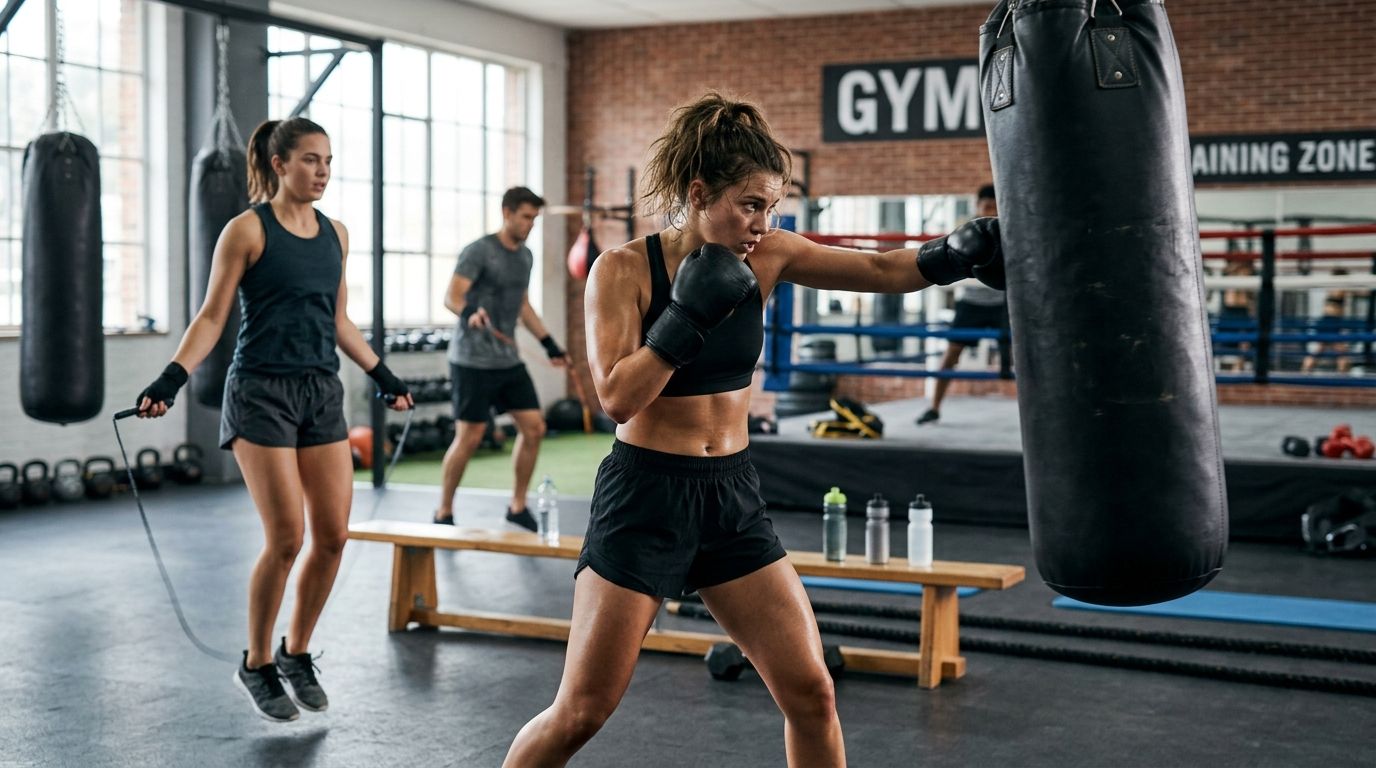
Boxing cross-training for college athletes is a supplemental conditioning method that borrows footwork, reaction drills, and mitt work from boxing to sharpen speed, balance, and hand-eye coordination for sports like basketball, wrestling, football, and soccer. Unlike a walk-on boxing club that trains toward sparring, cross-training for a varsity or club athlete skips contact and focuses on the movement mechanics that transfer to their primary sport. The constraint that makes this segment different: practice schedules, road trips, and NCAA eligibility rules around contact sports mean the training has to fit around a season, not replace it.
• Boxing cross-training for college athletes works best as 2-3 short sessions a week layered around practice, not a replacement for sport-specific conditioning. • Footwork and reaction drills transfer directly to basketball, wrestling, and soccer; live sparring does not belong in an in-season program. • Better Through Boxing runs this as live virtual 1-on-1 coaching, so a student on a dorm Wi-Fi connection can train between classes without a gym commute. • Mitt work only enters the program once footwork and guard mechanics are solid, usually after 3-4 sessions.
Why boxing cross-training matters for college athletes
A college athlete's calendar is the constraint every strength coach fights: practice, film, travel, class, and a lifting block that's already locked in by the team. Boxing cross-training earns its spot in that calendar because it hits three things at once — lateral footwork, reaction speed, and rotational core strength — in a 30-45 minute session that needs no field, court, or partner. The skills carry over concretely. A guard's closeout footwork and a boxer's pivot off the lead foot are the same movement pattern. A wrestler's hand-fighting and a boxer's parry share the same forearm tension and timing. A soccer player's change-of-direction cutting mirrors the slip-and-recover drill boxers run daily. None of this requires stepping into a ring in 2026 or any other year — it requires the mechanics, done correctly, on a repeatable schedule.
Build the program step by step
ASSESS YOUR CURRENT MOVEMENT BASELINE Before adding boxing drills, know what you're actually missing. Most college athletes have sport-specific strength but weak lateral reaction time and stiff hip rotation. • Time a 5-yard shuffle-and-react drill with a partner calling direction • Test single-leg balance for 30 seconds each side, eyes closed • Check hip rotation range standing versus in an athletic stance • Note dominant-side bias — most athletes overload one side by year three REBUILD FOOTWORK BEFORE YOU TOUCH HAND SPEED Boxing footwork is a stance-and-step system, not just "move your feet." Skipping this step is the single biggest reason cross-training plans stall out in week two. • Drill the basic boxing stance: feet shoulder-width, lead foot slightly turned in, weight centered • Practice the step-drag (never crossing feet) forward, back, and laterally • Add pivot-off-the-lead-foot reps to build the rotation used in cutting sports • Layer in shadow footwork patterns without punches for the first week • Film one set weekly to check stance width doesn't drift too narrow ADD REACTION AND HAND-SPEED DRILLS Once footwork holds under fatigue, reaction drills close the gap between seeing a cue and moving on it — the exact skill a point guard or free safety needs. • Reaction ball drills against a wall, alternating hands • Partner-called slip drills (no gloves needed) to sharpen head movement • Light-and-fast combinations on a bag or pads for hand speed, not power • Visual tracking drills using a tennis ball on a string This is the point where a structured plan starts to outperform a YouTube playlist, because sequencing footwork, reaction work, and mitt drills in the wrong order is what causes plateaus. Better Through Boxing's live virtual sessions build this progression with Coach Chris Persaud watching stance and timing in real time over Zoom, which matters more for correcting footwork drift than any pre-recorded app. LAYER IN MITT WORK FOR CONTROLLED CONTACT Mitt work is where boxing cross-training gets its conditioning payoff — short, explosive combinations with recovery windows that mimic a shift on the field or a possession on the court. • Start with 2-minute rounds, 1-minute rest, for 4-6 rounds • Focus combinations on footwork-punch pairing, not punch volume • Add defensive mitt reps (slip, parry, pivot) between offensive rounds • Track heart rate recovery between rounds as a conditioning marker Mitt work with a coach also solves the biggest practical problem for this segment: college athletes rarely have a reliable, boxing-literate training partner on campus. A private virtual session with a coach holding focus mitts on their end of the call, giving real-time footwork corrections, replaces that missing partner without requiring a gym membership or a car. PROGRAM CONDITIONING AROUND THE SEASON CALENDAR In-season and off-season boxing cross-training should not look the same. In-season, the goal is maintenance and injury prevention; off-season is when volume can climb. • In-season: 2 sessions a week, 30 minutes, low-impact footwork and reaction focus • Off-season: 3 sessions a week, up to 45 minutes, adding conditioning rounds • Taper volume the week of finals or a tournament, not the day before • Sync heavy conditioning days with the team's lighter practice days, not game days MANAGE RECOVERY AND INJURY RISK This is the step coaches skip and athletes regret. Boxing cross-training should never include live sparring for a college athlete carrying NCAA eligibility in another contact sport — the injury risk-to-reward ratio doesn't clear. • Keep all contact work to mitts and bags, never live sparring • Ice or compress wrists after heavy mitt sessions, a common overuse spot • Watch for shin splints from footwork drills done on hard gym floors • Report any wrist or shoulder pain to your athletic trainer before continuing SCHEDULE SESSIONS AROUND THE ACADEMIC AND GAME CALENDAR A dorm room or an off-campus apartment is a legitimate training space when the program is virtual. This is the scheduling advantage that makes cross-training realistic for a student-athlete instead of aspirational. • Book recurring session slots around class blocks, not around gym hours • Use virtual lessons on road-trip weeks to avoid a missed week entirely • Batch two shorter sessions instead of one long one during midterms • Keep a home base coach relationship rather than switching gyms each semester Book a live virtual boxing session Train footwork and mitt work from your dorm with Coach Chris Persaud.
Comparing your cross-training options
Verdict: for a college athlete without gym access, Better Through Boxing's live virtual coaching is the option that corrects footwork mechanics in real time — a solo app or a YouTube playlist can't do that.
Common mistakes college athletes make
• Skipping footwork to get to the "fun" hand-speed drills — punches without stance work build bad habits fast and undo weeks of progress. • Sparring live during the season — even light contact carries an injury risk no varsity program should accept mid-schedule. • Ignoring the off-hand side — most athletes already favor one side from their primary sport; boxing drills amplify that imbalance if both sides aren't drilled evenly. • Training at max volume during finals week — conditioning gains mean nothing if grades or eligibility take the hit. • Switching coaches every semester — inconsistent coaching resets the correction process on footwork and habits that took weeks to build.
FAQ
Is boxing cross-training safe for college athletes in another sport? Yes, when it stays limited to footwork, mitt work, and reaction drills with no live sparring. The injury risk comes almost entirely from contact, which a properly run cross-training program avoids. How many sessions a week should a college athlete do? Two sessions a week in-season and up to three in the off-season is a workable range for most college athletes in 2026, adjusted around practice and travel. Does boxing cross-training help basketball or wrestling specifically? Footwork and reaction drills transfer directly to closeout speed in basketball and hand-fighting timing in wrestling, since both rely on the same lateral stance mechanics boxing trains. Can this be done without a gym or equipment? Yes. Footwork, shadow drills, and reaction work need no equipment, and live virtual coaching sessions run over Zoom from a dorm room or apartment. Is live sparring ever appropriate for a cross-training program? No. Cross-training for a non-boxing athlete should stay limited to mitts, bags, and shadow work — live sparring adds injury risk without a proportional conditioning benefit. How does a college athlete fit this around road trips? A virtual session only needs a laptop or phone and a hotel room's worth of space, which is why remote-friendly formats hold up better than a gym-dependent plan during travel weeks. What's the difference between boxing fitness classes and real boxing cross-training? Fitness boxing classes cycle through punches for calorie burn with little coaching on mechanics. Cross-training built for an athlete corrects stance, footwork, and timing the way a boxing coach would train an actual boxer. Should a strength coach or a boxing coach run this program? A boxing coach should run the technique portions — stance, footwork, mitt work — since most strength staffs don't have that specific coaching background, while conditioning volume can still be coordinated with the team's strength program.
One last thing
The athletes who get the most out of boxing cross-training aren't the ones adding the most volume — they're the ones who nail footwork mechanics in the first two weeks and then let reaction and mitt work build on top of that base. Rushing to mitt work before footwork holds under fatigue is the single fastest way to waste a semester of sessions.
Train with Coach Chris
Ready to put this into practice with a coach watching every rep? Better Through Boxing is private, 1-on-1 coaching with Christopher Persaud — CoachUp's #1 ranked NJ trainer. Train live online over Zoom from anywhere in the world, or work the mitts in person across New Jersey. Book a session at betterthroughboxing.com and get real-time corrections on your stance, footwork, and punches.
Train anywhere with the Ronin Box app
Voice-cued boxing workouts, round timer, and progress tracking — coached by Chris, right in your pocket.

Scan to install