

Boxing Coaching for Law Enforcement Officers: 2026 Guide
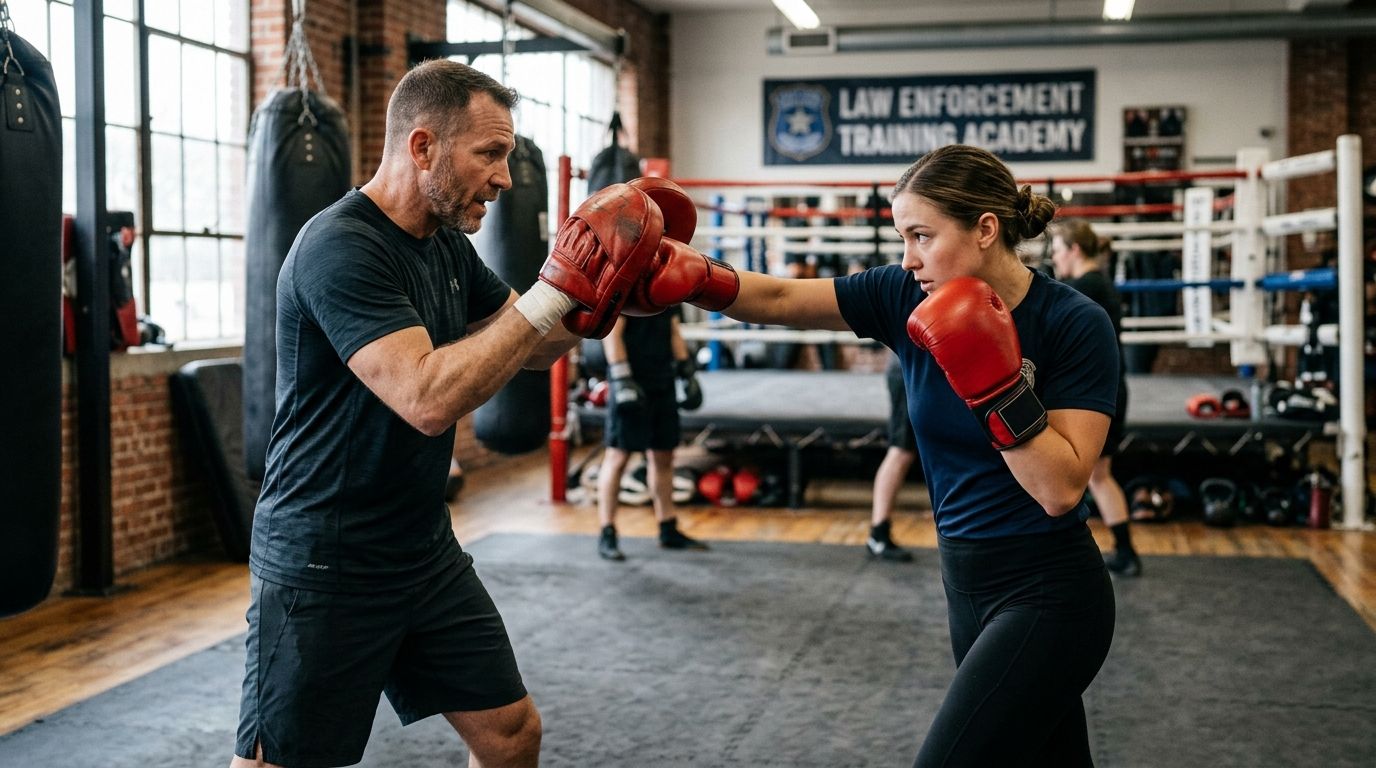
Boxing coaching for law enforcement officers is stress-tested striking and defense training built to hold up under adrenaline, close-quarters contact, and shift-driven schedules. Officers need mechanics that work when hands are shaking and seconds count, not a fitness-boxing class built for cardio numbers. The training also has to fit around rotating shifts, court dates, and mandatory overtime, which rules out a lot of standard gym schedules.
• Boxing coaching for law enforcement officers works best when it drills the Core 4 punches, slipping, and footwork under simulated stress, not just bag work. • Live virtual coaching from Better Through Boxing fits rotating shifts because sessions book around a patrol calendar instead of a fixed class time. • Private 1-on-1 mitt work catches bad habits (dropped hands, flat feet) that group classes miss in a shift-worker's limited training window. • Self-guided drills and YouTube tutorials are free but won't correct stance or timing errors that show up under real pressure.
Why this matters for officers
Officers train on a different clock than the average gym member. Rotating 8s, 10s, or 12s mean a Tuesday 6pm class this week is a Tuesday 6am shift next week, and most commercial gyms won't rebuild a schedule around that. Live virtual sessions solve the scheduling problem directly since a Zoom lesson can move to whatever window is open on a given week, in-home or at the station before or after a shift. The physical demand is also different. A boxer trains to win rounds; an officer needs mechanics that hold up in an unplanned, close-range physical encounter where there's no referee and no rest between rounds. That means real stance work, real slipping and pivoting, and conditioning that mimics a sustained grapple rather than a three-minute round. Live virtual coaching built around 1-on-1 correction catches those gaps faster than a group class where a coach is watching ten people at once.
Build the skill set step by step
SET A FIGHT-READY STANCE AND BASE FOOTWORK Everything starts here. A stance that's too square or too narrow gets an officer knocked off balance in the first exchange. • Practice the boxing stance against a wall for 5 minutes daily to check shoulder and hip alignment • Drill forward, backward, and lateral steps without crossing the feet • Shadowbox in front of a mirror to catch a collapsing back knee • Add a resistance band around the ankles for 10 reps of step-and-reset drills • Film short clips on a phone and compare frame-by-frame against a stable base SHARPEN DEFENSIVE REFLEXES UNDER STRESS Slipping, blocking, and rolling matter more than throwing punches when the goal is control, not knockout. • Drill slip-left, slip-right against a partner tossing a tennis ball • Practice the shoulder roll against slow, telegraphed jabs • Work high-guard blocking in 30-second bursts to build shoulder endurance • Add reaction-ball drills to cut response time to visual cues • Layer in verbal-command drills, reacting to a shout instead of a visual trigger TRAIN THE CORE 4 PUNCHES FOR CLOSE-QUARTERS CONTROL Jab, cross, hook, uppercut cover most of what an officer needs in a tight space. Precision matters more than power here. • Drill the jab against a wall target to fix elbow flare • Pair the cross with hip rotation, not arm extension alone • Work the hook at close range where most real contact happens • Add uppercuts from a bent-knee position to simulate grappling range • Combine all four into 3-punch combinations under a timer • Book a private mitt-work session for real-time feedback on distance and timing, since a coach calling combinations live corrects habits a solo drill can't CONDITION FOR SUSTAINED PHYSICAL CONFRONTATIONS A scuffle doesn't end after 3 minutes. Conditioning has to match that reality. • Run 4-minute rounds of shadowboxing to build past the standard 3-minute round • Add weighted vest work to simulate gear load • Do burpee-to-punch combinations for full-body fatigue resistance • Train grip endurance with towel-hang holds • Finish sessions with a 60-second all-out combination drill under fatigue ADD MITT WORK FOR REAL-TIME DECISION MAKING Mitts force an officer to react instead of memorize a pattern, which is closer to a real encounter than solo bag work. • Start with called combinations at a controlled pace • Progress to random combinations with no set order • Add a defensive requirement between every strike (slip, block, or step) • Introduce a second mitt holder to simulate a multi-person scenario • Track combination accuracy over a set number of rounds, not just punch count SCHEDULE LIVE VIRTUAL SESSIONS AROUND SHIFT WORK This is where most gym-based programs fall apart for shift workers. A virtual boxing training program that runs on Zoom removes the commute and the fixed class slot entirely. • Block recurring sessions during predictable days off • Use a rolling 2-week booking window instead of a fixed weekly slot • Keep a home setup (wraps, gloves, a target pad) ready for short-notice sessions • Request session recaps to review footwork or punch correction between sessions • Rotate session length (30 vs 60 minutes) based on shift fatigue PRESSURE-TEST WITH CONTROLLED SPARRING OR SIMULATION DRILLS Skills that only exist in drills don't transfer. Controlled pressure testing closes that gap safely. • Run light-contact sparring rounds focused on control, not scoring • Add scenario drills that start from a grab or push, not a clean stance • Debrief every round immediately, not at the end of a session • Track which techniques break down first under fatigue • Log progress across 4-6 weeks to measure real change, not a single session's performance
Comparing training options for officers
Live virtual private coaching is the practical default for most shift-working officers in 2026 because it removes the two biggest blockers, commute time and fixed scheduling, without cutting the 1-on-1 correction that group classes can't provide. “An officer's stance has to hold up on the fourth grab of the night, not just the first jab of the round.”
Common mistakes officers make
• Training power before control. Officers coming from a general fitness background often chase punch power and skip footwork, which leaves them off-balance in a close encounter. • Skipping defensive reps. Punching drills get more attention than slipping and blocking, even though defense is what actually matters in a real confrontation. • Training only during scheduled shifts off. Locking into one fixed weekly slot means missed sessions every time the schedule rotates, which is most weeks. • Treating conditioning like a normal boxing round. A standard 3-minute round doesn't prepare for a sustained, unscripted physical encounter that can run well past that. • Never pressure testing. Drilling combinations in isolation without any live resistance means the first real test of the skill happens on duty instead of in training. Book a virtual assessment Live 1-on-1 sessions built around rotating shifts.
FAQ
What's the best boxing coaching for law enforcement officers with rotating shifts? Live virtual private coaching works best for rotating shifts because sessions can be rebooked around a changing schedule instead of a fixed weekly class slot. In-person coaching works too but requires travel time most rotating shifts don't allow. Is boxing better than defensive tactics training for officers? Boxing builds the striking mechanics, footwork, and defensive reflexes that defensive tactics programs assume officers already have. The two are complementary rather than competing; boxing sharpens the hand skills and balance that make department-mandated defensive tactics work better under stress. How much do private boxing lessons cost for officers in 2026? Pricing varies by coach, format, and session length; check current rates directly with a private coach rather than relying on a general estimate. A full breakdown of typical private lesson pricing is available on the cost of private boxing lessons guide. Do I need boxing experience before starting as an officer? No experience is necessary. Coaching for this segment typically starts with stance and footwork fundamentals before adding the Core 4 punches, defense, and conditioning. Can virtual boxing coaching actually replace in-person mitt work? Virtual coaching replaces the coaching relationship and real-time correction, not the physical mitt contact. Officers doing virtual sessions typically use a target pad or wall target at home while the coach calls combinations and corrects form live over video. How often should an officer train boxing per week in 2026? Two sessions a week is a workable baseline for building stance, defense, and conditioning without overloading a rotating shift schedule. Officers with more available time can add a third session focused on conditioning or pressure testing. Does boxing training help with use-of-force reporting or department requirements? Boxing coaching is not a substitute for a department's mandated defensive tactics or use-of-force curriculum. It supplements those programs by improving the striking mechanics, balance, and reflexes those curriculums assume officers already have.
One last thing
The detail most officers skip is footwork under fatigue, not punch power. An officer who can still reset their base after 90 seconds of hard conditioning controls range far better than one throwing harder punches from a collapsed stance, and that's the difference that shows up in a real encounter, not on a heavy bag.
Train with Coach Chris
Ready to put this into practice with a coach watching every rep? Better Through Boxing is private, 1-on-1 coaching with Christopher Persaud — CoachUp's #1 ranked NJ trainer. Train live online over Zoom from anywhere in the world, or work the mitts in person across New Jersey. Book a session at betterthroughboxing.com and get real-time corrections on your stance, footwork, and punches.
Train anywhere with the Ronin Box app
Voice-cued boxing workouts, round timer, and progress tracking — coached by Chris, right in your pocket.

Scan to install