

Best Boxing Reaction Drills for Hand Speed in 2026
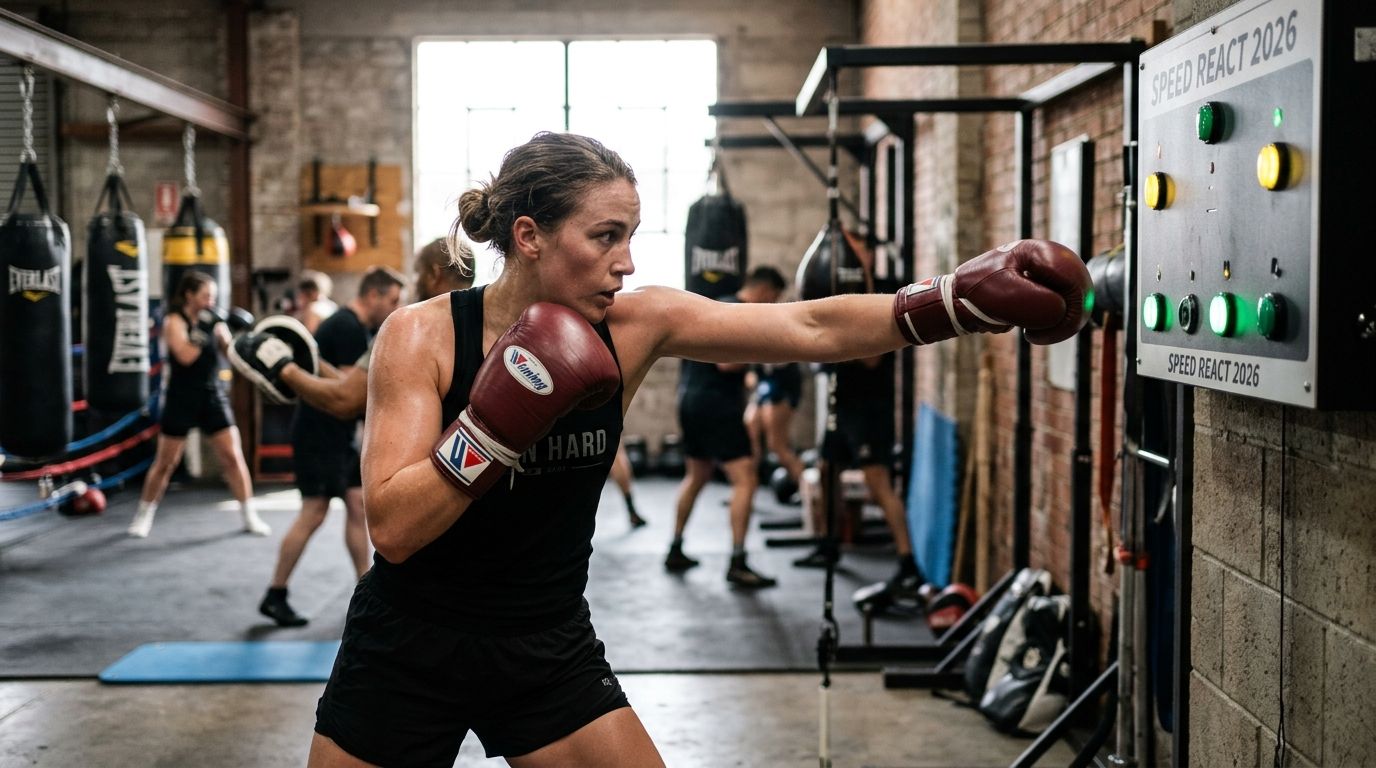
Six boxing reaction drills, ranked for how fast they actually build hand speed rather than just raise a heart rate, from live mitt work with a coach down to phone-based reactive light apps you can run alone in 2026.
• Live mitt work with call-and-react combinations is the best boxing reaction drills for hand speed pick when a coach is available. • Reaction ball drills win as the best low-equipment option for solo training at home. • Double-end bag work sharpens punch rhythm and timing better than a static heavy bag ever will. • Virtual Zoom sessions with Coach Chris Persaud reproduce live call-and-react coaching for anyone training from home. • Slip rope and app-based light drills work best as add-ons, not a full reaction-training program on their own.
Why this matters
Hand speed and reaction speed are not the same skill, and most home workouts only train one of them. You can throw a fast jab all day at a heavy bag and still get clipped by a counter you never saw coming, because the bag never asks you to decide anything. A real reaction drill forces a choice under time pressure: which punch, which angle, which defense, right now. That's the gap between shadowboxing fast and actually being fast in a boxing sense. Better Through Boxing builds every private session, in person or over Zoom, around that distinction rather than raw rep counts. The six drills below are ranked on how well they replicate that decision-under-pressure demand, not on how tired they make you. Best overall: live mitt work with call-and-react combinations. Best for solo training: reaction ball drills. Best for rhythm and timing: double-end bag work. Best for defensive reaction: slip rope drills.
What makes the best boxing reaction drill
• Unpredictability — the stimulus has to change, not repeat a memorized pattern you can anticipate • Instant feedback — a bounce, a mitt shift, or a flashing light tells you immediately if the reaction landed • Transfer to sparring — the drill should mirror what actually happens when an opponent throws first • Low setup friction — gear you can access consistently beats gear that sits in a closet • Scalability — the same drill should work for a first-week beginner and a competitor, just at different speeds
1. Live mitt work with call-and-react combinations: best for fight-realistic hand speed
A coach holds mitts and calls or shifts combinations without a memorized sequence, so you're reacting to a decision made half a second earlier, not executing a routine. This is the closest a drill gets to sparring speed without the risk of getting hit. Live mitt work pros: • Closest simulation to an actual opponent's timing • Coach adjusts difficulty in real time as your reaction improves • Builds speed and power together instead of isolating one • Works from a beginner's first session through a competitor's fight camp Live mitt work cons: • Requires a coach or a genuinely skilled partner, not a friend holding pads • Scheduling depends on someone else's availability • Hard to replicate the unpredictability alone Best for: fight-realistic hand speed. Verdict: Buy — prioritize this drill above the rest if you have access to a coach at all, in person or over live coaching built around real mitt work.
2. Reaction ball drills: best for solo home training
A multi-sided rubber ball bounces off a wall or the floor at an angle you can't predict, and you catch it or punch it before it settles. The randomness is the entire point — a normal ball bounces the same way every time, this one doesn't. Reaction ball pros: • Works completely solo, no partner or coach needed • Small enough to travel in a gym bag • Scales from simple catches to punch-and-catch combinations Reaction ball cons: • Doesn't train punch mechanics, footwork, or defense • Bouncing off the same wall repeatedly gets predictable if you never change the angle Best for: solo home training. Verdict: Buy — the single best low-equipment addition for days without a coach or partner.
3. Double-end bag drill: best for punch rhythm and timing
A bag anchored by cords top and bottom rebounds unpredictably after every punch, forcing you to track its return and time the next shot instead of throwing on a fixed count. Good hands on a double-end bag look nothing like good hands on a heavy bag. Double-end bag pros: • Builds rhythm and timing that a static heavy bag can't teach • Sharpens accuracy while moving instead of standing still • Trains flow between punches, not isolated reps Double-end bag cons: • Frustrating for total beginners — bad technique makes the bag swing wildly and unproductively • Needs proper anchor points, floor and ceiling or a stand Best for: punch rhythm and timing. Verdict: Hold — get basic hand speed and stance down first, then add this drill once punches land with intent.
4. Slip rope drills: best for defensive reaction
A rope or elastic band strung at head height gives you a fixed target to slip or duck under while shadowboxing, training head movement reaction on a repeatable rhythm you gradually speed up. Slip rope pros: • Trains defensive reaction and head movement with zero risk of getting hit • Cheap setup — a rope and two anchor points • Works in a garage or a bedroom Slip rope cons: • Builds no punching speed on its own • Rhythm can become memorized fast if you don't vary the tempo Best for: defensive reaction speed. Verdict: Buy — as a complement to punching drills, not a replacement.
5. Virtual Zoom reaction drills with a coach: best for training from home
The same call-and-react coaching model as in-person mitt work, delivered live over video. A coach watches your stance and footwork on camera and calls combinations in real time, with no memorized script to fall back on. Virtual reaction drills pros: • Same live unpredictability as in-person coaching • No travel — available anywhere with a laptop or phone • Only needs floor space and a stable connection Virtual reaction drills cons: • No mitts to catch power shots, so contact feedback is limited • Requires decent video quality and enough room to move freely Best for: training from home with real coaching. Verdict: Buy — virtual boxing programs close most of the gap between solo drills and in-person mitt work. Get live reaction coaching, not just drills Private call-and-react mitt work with Coach Chris Persaud, in person or over Zoom.
6. App-based reactive light training: best for tech-assisted tracking
A phone screen or standalone light unit flashes in random patterns and you punch or tap in response, with some apps logging your reaction time in milliseconds so you can track it week to week. App-based training pros: • Gives you an actual number to track over time • Gamified enough to keep beginners engaged • Works in short bursts between other drills App-based training cons: • Reacting to a light isn't the same as reacting to an actual punch • Doesn't teach distance, angle, or defense Best for: tech-assisted, trackable reaction training. Verdict: Hold — useful as a supplement, weak as your only reaction drill.
How this list was ranked
Each drill was scored against the five criteria above: unpredictability, feedback speed, transfer to sparring, setup friction, and scalability across skill levels. Drills that only satisfied one or two criteria — like app-based lights, strong on feedback but weak on transfer — landed lower even when they're genuinely useful as add-ons. “If you can't react to a punch that wasn't called out loud, you can't react to one you never saw coming either.”
Which boxing reaction drill should you choose?
If a coach is available at all, in person or over Zoom, live mitt work with call-and-react combinations wins for 2026 — nothing solo replicates a live, decision-based combination. Training alone most days, pair a reaction ball with slip rope work and use an app to track raw reaction time on off days. Add double-end bag work once your fundamentals are solid enough that bad technique doesn't turn every session into chasing a swinging bag.
FAQ
What's the best boxing reaction drill for hand speed? Live mitt work with call-and-react combinations is the best boxing reaction drill for hand speed in 2026 because a coach varies the combination in real time instead of letting you memorize a pattern. Reaction ball drills are the best option when training alone. Can I improve boxing hand speed without a coach? Yes, reaction ball drills, slip rope work, and app-based reactive lights all build hand speed solo. None fully replicates the unpredictability of a coach calling live combinations, so results plateau faster without one. How long should a reaction drill session last? Most reaction drills work best in short, high-focus bursts of 2-3 minute rounds rather than long continuous sessions, since reaction quality drops fast once fatigue sets in. Three to five rounds per drill is enough to see progress week over week. Is a reaction ball actually good for boxing? Yes, a reaction ball is genuinely useful for boxing because its unpredictable bounce trains the eyes and hands to work together under time pressure. It doesn't teach punch mechanics or footwork, so it works best alongside coached drills, not instead of them. Do boxing apps improve real fight speed? Boxing apps that track reaction time to a flashing light improve raw visual reaction and give you a number to track, but they don't teach distance, angle, or defense. Treat them as a supplement to coached or partner drills, not a replacement. How often should reaction drills be trained? Two to four sessions a week is enough for most beginners through intermediate boxers, since reaction training taxes focus more than muscles. Competitors preparing for a fight often add a short reaction block daily on top of regular sparring and mitt work. Is virtual boxing coaching effective for reaction speed? Yes, virtual coaching over Zoom reproduces the same live call-and-react model as in-person mitt work, since a coach can still call combinations in real time on camera. The main tradeoff is no mitts to absorb power shots, so contact feedback is limited compared to in-person sessions. What's the difference between hand speed and reaction time? Hand speed is how fast your hands move once you've decided to punch, while reaction time is how fast you decide in the first place. A boxer can have fast hands and still get hit often if reaction time to an opponent's movement is slow.
One last thing
Average human visual reaction time hovers around 200 milliseconds and that number is largely fixed by biology — you're not going to train it down much. What actually improves with drills like call-and-react mitt work is anticipation: reading a shoulder or a hip shift before the punch even starts, which effectively buys you time the raw reaction number never will. That's the real reason live coaching outranks solo drills on this list, not because a coach makes your reflexes faster, but because a coach teaches you what to look for before the punch arrives.
Train with Coach Chris
Ready to put this into practice with a coach watching every rep? Better Through Boxing is private, 1-on-1 coaching with Christopher Persaud — CoachUp's #1 ranked NJ trainer. Train live online over Zoom from anywhere in the world, or work the mitts in person across New Jersey. Book a session at betterthroughboxing.com and get real-time corrections on your stance, footwork, and punches.
Train anywhere with the Ronin Box app
Voice-cued boxing workouts, round timer, and progress tracking — coached by Chris, right in your pocket.

Scan to install